
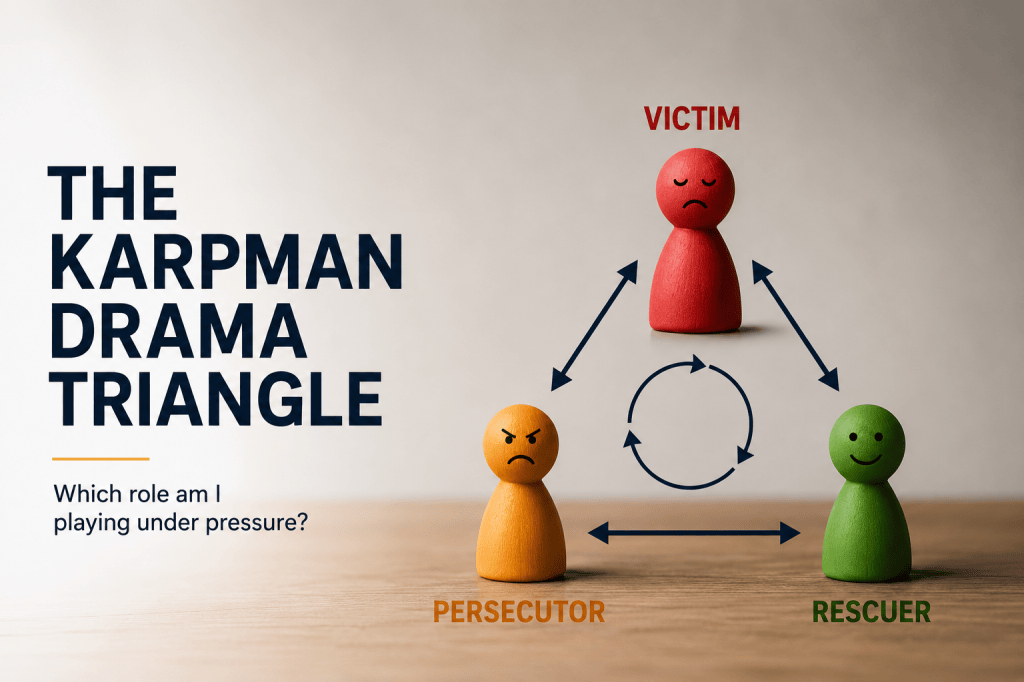
Which role am I playing under pressure?
Under pressure, even experienced leaders and negotiators can fall into surprisingly predictable relational patterns.
A disagreement becomes personal. Someone starts blaming. Someone else feels powerless. A third person jumps in to solve a problem nobody asked them to solve.
And suddenly, instead of solving the problem, everyone is playing a role.
In 1968, psychiatrist Stephen B. Karpman introduced the Drama Triangle, a model from Transactional Analysis describing three roles that can emerge in difficult relationships: Victim, Persecutor and Rescuer.
The important point is that these are not personality types.
They are positions we can adopt in an interaction.
And we can switch between them surprisingly quickly.
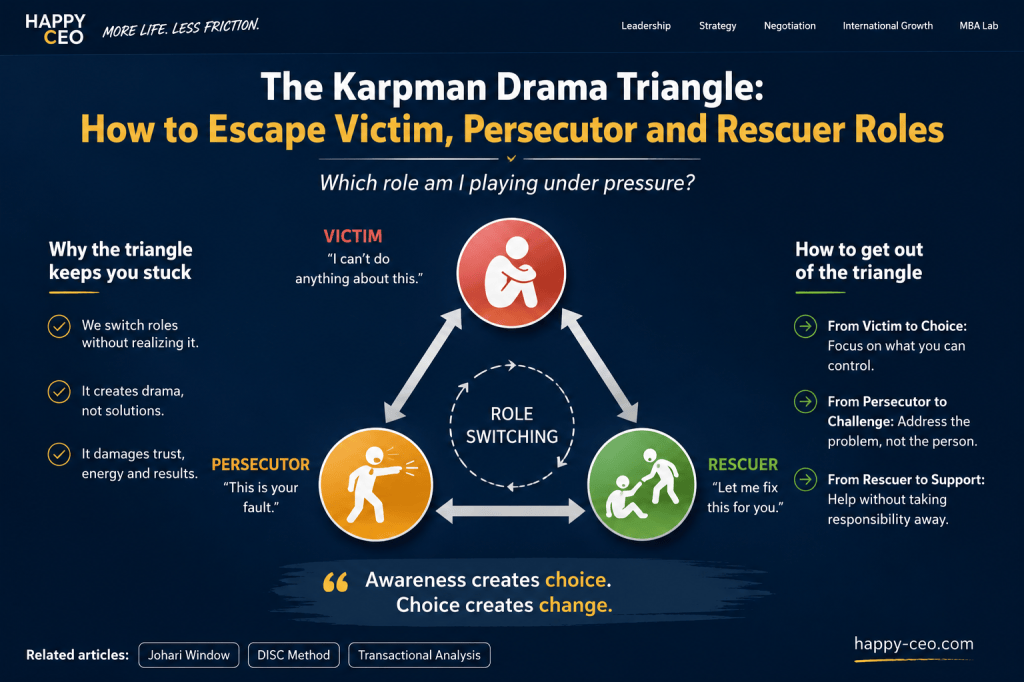
The Karpman Drama Triangle: Victim, Persecutor and Rescuer roles can shift during conflict, pressure and negotiation.
The three roles
VICTIM — “I can’t do anything about this.”
The Victim position feels powerless.
The problem is caused by the client, the boss, the market, the team, the other negotiator or simply bad luck.
There may be a genuine problem. But the Victim position reduces the ability to see choices:
“There is nothing I can do.”
PERSECUTOR — “This is your fault.”
The Persecutor criticizes, blames, judges or attempts to control.
Again, the underlying frustration may be perfectly legitimate.
The problem begins when challenging an issue becomes attacking a person:
“You never listen.”
“Your team is the problem.”
“You clearly don’t understand.”
RESCUER — “Let me fix this for you.”
The Rescuer wants to help.
That sounds positive. And sometimes it is.
But rescuing becomes problematic when we take responsibility for something that belongs to someone else.
We solve instead of supporting.
We answer instead of asking.
We protect people from consequences they need to manage themselves.
“Don’t worry. I’ll handle it.”
The dangerous part: we switch roles
Karpman’s original model is dynamic. The drama comes particularly from movement between the roles.
A Rescuer who feels unappreciated may become a Persecutor:
“After everything I’ve done for you…”
A Persecutor who receives strong resistance may suddenly feel like the Victim:
“Why is everybody against me?”
And a Victim may become a Persecutor:
“This is all your fault.”
People can move between the three roles during the same interaction, sometimes very quickly and without realizing it. Recognizing the role we are playing at a particular moment can help us understand our reaction and regain control of the conversation.
A useful question to ask yourself is: “Which role am I playing right now?”
The Drama Triangle in negotiation
Negotiation provides perfect conditions for the triangle to appear.
There is uncertainty, pressure, disagreement, dependency, ego and sometimes a lot of money on the table.
The Victim may believe there is no alternative and accept a bad deal.
The Persecutor may use blame, aggression or excessive pressure and damage the relationship.
The Rescuer may make unnecessary concessions simply to remove tension or save the relationship.
And roles can switch during the same negotiation.
This is why self-awareness matters.
Before diagnosing the behaviour of the person across the table, observe your own.
How to get out of the triangle
Recognizing the triangle is useful. Leaving it is better.
Instead of Victim → recover choice.
What can I control?
What options do I still have?
What is my BATNA?
What can I decide now?
Instead of Persecutor → challenge the problem, not the person.
What exactly is unacceptable?
What fact can I describe without accusation?
What question could replace my judgement?
Instead of Rescuer → help without taking ownership.
Did the other person actually ask for my help?
Whose responsibility is this?
Can I support them without solving the problem for them?
The objective is not to become passive, endlessly agreeable or artificially nice.
It is to recover choice, responsibility and productive communication.
A 5-minute self-awareness exercise
Think about a recent difficult conversation, conflict or negotiation.
Ask yourself:
- Which role did I play first?
- What triggered me?
- Did I switch roles during the interaction?
- What did I expect from the other person without clearly asking for it?
- What could I have said or done differently?
Then ask the uncomfortable question: What was I doing that helped keep the drama alive?
Awareness creates choice. And choice gives you the possibility to change the next move.
In summary
- The Karpman Drama Triangle describes three relational roles: Victim, Persecutor and Rescuer.
- They are roles, not personality types.
- Victim: “I have no choice.”
- Persecutor: “This is your fault.”
- Rescuer: “I’ll solve this for you.”
- People can switch rapidly between roles during the same interaction.
- Pressure, conflict and negotiation can make these patterns particularly visible.
- Don’t use Karpman to label other people. Use it first to examine your own behaviour.
- Move from helplessness to choice, from blame to assertiveness, and from rescuing to support with responsibility.
- When tension rises, ask: “Which role am I playing right now?”
“Drama grows when responsibility disappears. Change begins when choice returns.”
Happy CEO
References & Go Further
- Stephen B. Karpman — Fairy Tales and Script Drama Analysis (1968), original Drama Triangle article
- Stephen B. Karpman — Script Drama Analysis II, International Journal of Transactional Analysis Research & Practice (2019)
- Stephen B. Karpman — Official Karpman Drama Triangle website
Related Happy CEO articles
Navigating the Johari Window: Self-Discovery and Connection
Mastering Negotiation Styles with the DISC Method
Who Are You Talking To? Why You Should Learn Transactional Analysis
 Happy CEO | Leadership, Strategy & International Growth