
A practical guide to implement a Lean strategy for growth
We implemented a Hoshin Kanri approach in X in industrial SMEs. Most operational employees had difficulty perceiving the logic due to its X structure.
However, it is essential to the presentation of the manager’s vision and the operational strategic implementation.
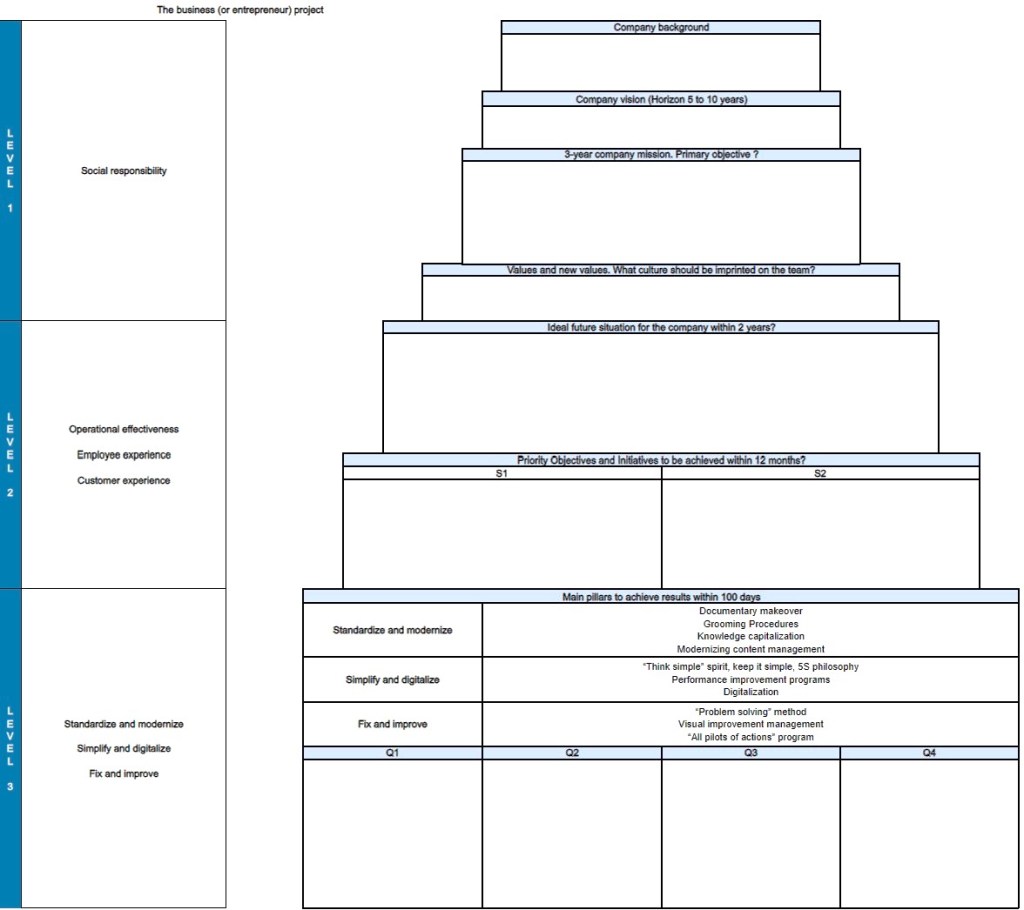
The first modification to our continuous improvement management strategy was to rethink the Hoshin Kanri Matrix and imagine a simplified, educational version aligned with the vision, mission and values of the company.
We have redesigned the Matrix in pyramid form with a breakdown of the Vision, Missions, Values and Strategy up to the action plan and associated Gantt per person.
We divided the pyramid into 3 distinct floors :
- Social responsability : Vision, mission, values, objectives
- Value creation : Operational effectiveness. Employee experience. Customer experience
- Business transformation : Standardize & modernize. Simplify & digitalize. Fix & improve.
Level 1 of the pyramid: Corporate social responsibility
Your company has a social responsibility which is a key element of its business strategy.
Social responsibility is about balancing profitable activities with activities useful to society.
It involves creating businesses that maintain a positive relationship with the society in which they operate.
These topics are essential for developing and disseminating your social responsibility strategy, which can allow you to improve your image, recruit and retain talent, retain customers, innovate more and contribute to positive social change.
How to formulate and transmit them effectively?
Many companies are aware of their social responsibility, but they do not always have a clear and coherent framework to guide their actions. They sometimes have to choose between profit and meaning, or they struggle to evaluate and communicate their social impact.
This simplified Hoshin Kanri method will help you design a clear and attractive social responsibility strategy for your company.
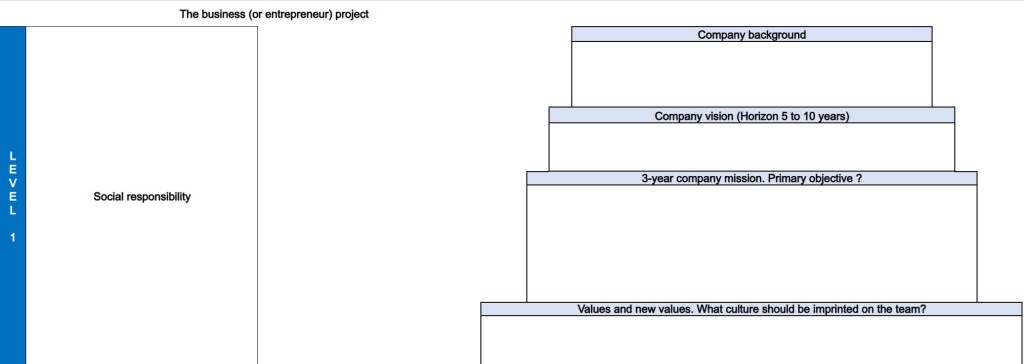
- The background of your company:
How does your company contribute to social good, what are the social issues that affect your industry, how do you address them, what are the benefits and challenges of being socially responsible? - The vision of your company:
What is your long-term aspiration for creating social impact, how do you align your vision with the needs and expectations of your stakeholders, what are the opportunities and risks of pursuing your vision? - The mission of your company for 3 years:
What is your specific and measurable goal for achieving social change, how do you integrate your mission with your core business activities, what are the strategies and actions that you will implement to reach your mission? - The values and new values of your company:
What are the ethical principles and standards that guide your decision-making and behavior, how do you communicate and demonstrate your values to your team and your stakeholders, how do you foster a culture of social responsibility in your organization?
Level 2 of the pyramid: Value creation
The second level of the Hoshin Kanri method covers the middle term of the strategy, which is usually between one and two years.
It aims to define the ideal future situation for the company within this time frame, and the priority objectives and initiatives to be achieved within 12 months.
These objectives and initiatives are then broken down into two semesters, with specific indicators and targets to measure the progress and results.
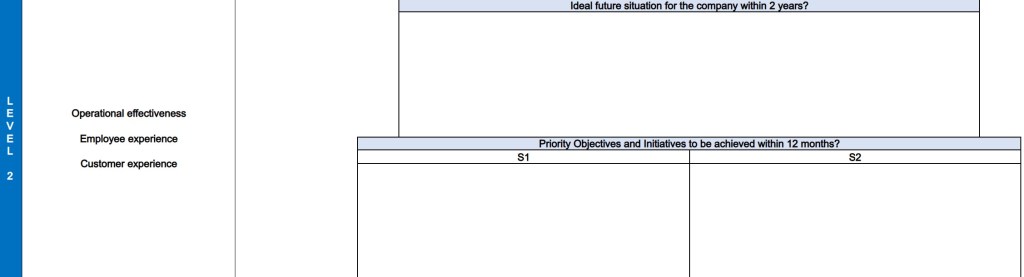
The second level also involves applying three filters to the objectives and initiatives:
- Operational effectiveness
- Employee experience
- Customer experience
These filters help to ensure that the strategy is aligned with the company’s values, mission, and vision, and that it creates value for all the stakeholders.
They also help to identify potential synergies, trade-offs, and gaps between the different aspects of the strategy.
The second level is a crucial step in translating the long-term vision into concrete actions and outcomes.
It requires a clear understanding of the current situation, the desired future situation, and the gap between them.
It also requires a collaborative approach involving all the relevant actors in the company, such as managers, employees, customers, suppliers, etc.
The second level is not a static document, but a dynamic and flexible tool that can be adapted and revised according to the changing environment and feedback.
Level 3 of the pyramid: Business transformation
Business transformation is the process of changing the way a company operates and delivers value to its customers, employees, and stakeholders.
It involves adopting new technologies, processes, systems, and strategies to improve the performance, efficiency, and competitiveness of the company. For example, simplifying and digitalizing processes can help standardize and modernize products, which in turn can help fix and improve customer satisfaction.
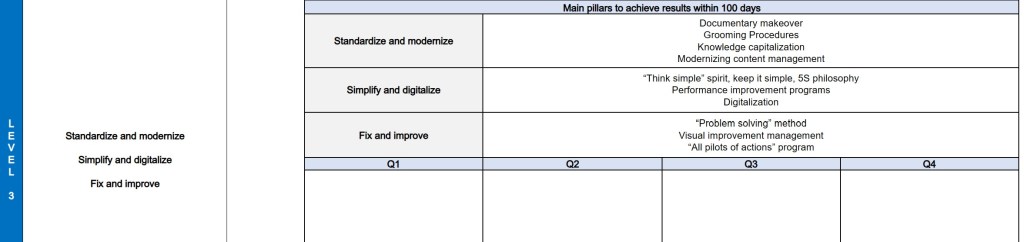
Standardize and modernize, simplify and digitalize, and fix and improve are all related to business transformation in different ways.
- Standardize and modernize : how the company aligns its operations and products with the best practices and standards in the industry and the market. It affects the quality, consistency, and innovation of the output.
- Simplify and digitalize : how the company reduces complexity and increases automation in its processes and systems. It affects the speed, agility, and scalability of the operations.
- Fix and improve : how the company identifies and resolves issues and gaps in its performance and customer satisfaction. It affects the reliability, effectiveness, and growth of the company.
By regrouping these three topics under the umbrella of business transformation, the company can have a more comprehensive and coherent view of its strategy. By applying these concepts, the company can improve its quality, consistency, innovation, speed, agility, scalability, reliability, effectiveness, and growth.
Level 4 of the pyramid: The Gantt
A Gantt chart will help to visualize the timeline, the dependencies, the progress, and the status of each task and the overall project. It will also communicate the project plan and expectations to the stakeholders, such as the customers and the employees.
Aligning value creation and business transformation with social responsibility :
- To define the ideal future situation for the company within two years, and the priority objectives and initiatives to be achieved within 12 months, by showing the start and end dates, the duration, and the sequence of each task.
- To apply the three filters of operational effectiveness, employee experience, and customer experience, by showing the resources allocated, the indicators and targets measured, and the value delivered for each task.
- To identify and leverage the interconnections and synergies between standardize and modernize, simplify and digitalize, and fix and improve, by showing the dependencies and links between the tasks.
- To monitor and control the project performance, efficiency, and competitiveness, by showing the actual vs. planned progress, the variance, and the issues of each task.
- To adapt and revise the project plan according to the changing environment and feedback, by allowing easy updates and modifications of the tasks.
“Excellence comes from the pursuit of perfection in every aspect of our operations.”
Our journey towards a simplified Hoshin Kanri approach underscores the importance of aligning strategic planning with our core values and social responsibility. Just as Taichi Ohno’s principles of lean thinking emphasized continuous improvement, our adaptation seeks to streamline complexity while fostering excellence.
In embracing this approach, we echo the spirit of Taichi Ohno’s relentless pursuit of efficiency and value creation.
Our simplified Hoshin Kanri approach enables us to deliver value where it matters most—to our customers, employees, and society at large.
In summary, Simplified Hoshin Kanri: Aligning strategy, responsibility, and excellence
- In embracing Hoshin Kanri for SME strategic planning, we’ve simplified our approach. While initially complex for operational employees, aligning the manager’s vision with practical implementation is vital.
- Our solution: a streamlined pyramid-shaped Hoshin Kanri Matrix. At its base is corporate social responsibility—balancing profit with societal good. We’ve crafted a simplified method to clarify and communicate social responsibility strategies.
- The next level, value creation, sets a clear path for the company’s future, aligning with operational effectiveness, employee experience, and customer experience filters.
- At the pyramid’s peak is business transformation, where we reshape operations, systems, and strategies for improved performance. We standardize, simplify, and fix to enhance quality and competitiveness.
- To navigate this journey, we employ Gantt charts for clear timelines and progress tracking, fostering efficient communication.
- In the spirit of Taichi Ohno, our simplified Hoshin Kanri approach aligns value creation and transformation with social responsibility, delivering where it matters most—to customers, employees, and society.
“Almost all quality improvement comes via simplification of design, manufacturing, layout, processes, and procedures.”
Tom Peters
 Happy CEO