
A tool for aligning vision, goals and actions
Hoshin Kanri is a strategic planning model that originated in Japan and is based on the principles of lean management.
It is a method of continuous improvement that can help entrepreneurs align their daily work with their long-term goals. It eliminates the waste that comes from inconsistent direction and poor communication.
The Hoshin Kanri method can work for international businesses as well, as it can help them align their global and local strategies, communicate effectively across different cultures and regions, and adapt to changing market conditions.
The model uses a visual tool called the Hoshin X matrix, which shows the relationship between the objectives, strategies and tactics of an organization.
The Hoshin Kanri model can help entrepreneurs in their strategic thinking.
Top benefits of the Hoshin Kanri model
- Providing a clear direction and vision for the future of their business and motivates everyone to achieve it.
- Breaking down the big goals into smaller and manageable actions that can be assigned to different teams or individuals.
- Reducing waste and inefficiency by eliminating activities that are not aligned with the goals and strategies of the organization.
- Monitoring the progress and performance of the actions and adjusting them as needed based on feedback and data.
- Encouraging a culture of learning and innovation that fosters continuous improvement and problem-solving by learning from failures.
- Improving communication and collaboration across the organization and creates a culture of trust and empowerment.
The Hoshin Kanri model differs from other strategic models
- It focuses on aligning the vision, goals, strategies and actions of the entire organization, from top to bottom, and ensuring that everyone is working towards the same direction.
- It uses a visual tool called the Hoshin X matrix, which shows the relationship between the objectives, strategies, tactics and measures of the organization, and helps to identify gaps and overlaps.
- It involves a participatory process called catchball, which is a way of exchanging ideas and feedback between different levels of the organization until everyone agrees on the plan.
- It emphasizes continuous improvement and learning by monitoring the progress and performance of the actions and adjusting them as needed based on data and feedback.
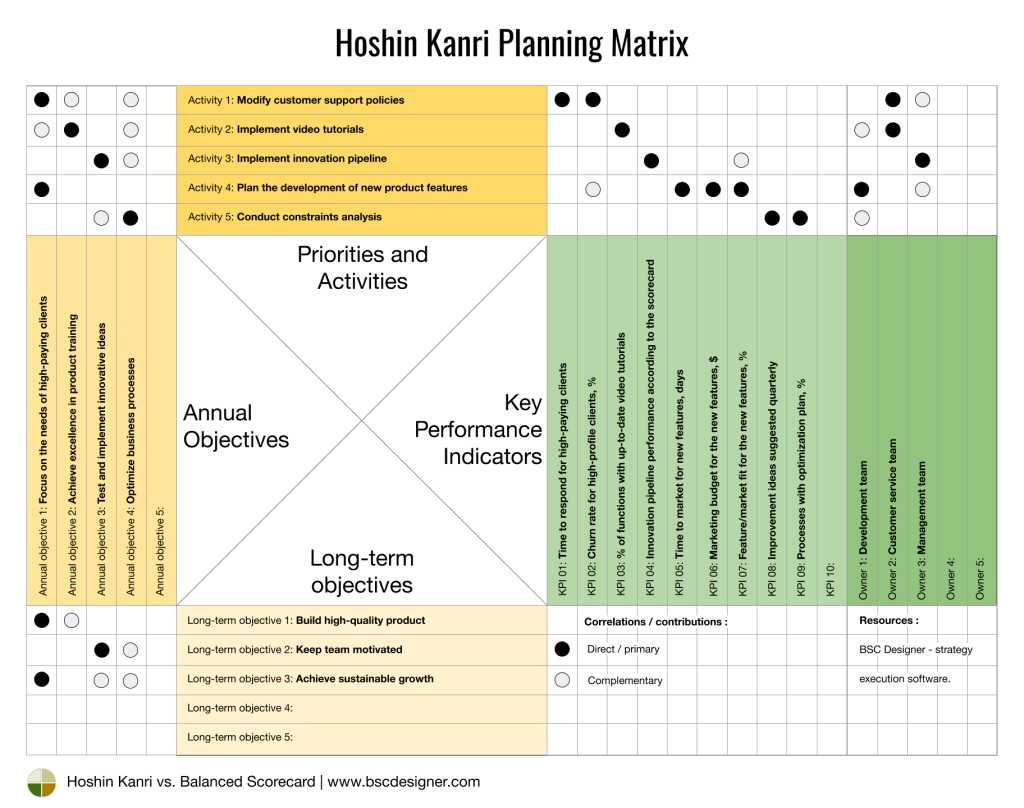
The 4 matrix quadrants that form an X shape
- The bottom quadrant contains the long-term goals or vision of the organization, usually for a period of 3 to 5 years.
- The left quadrant contains the annual objectives or key performance indicators (KPIs) that are derived from the long-term goals and reflect the current priorities of the organization.
- The top quadrant contains the priority actions or initiatives that are required to achieve the annual objectives. These are usually assigned to specific teams or individuals who are responsible for their execution.
- The right quadrant contains the measures or metrics that are used to monitor and evaluate the progress and impact of the priority actions.
- The corners of the matrix show the dependencies or relationships between the different quadrants. For example, the bottom-left corner shows how the annual objectives support the long-term goals, while the top-right corner shows how the measures reflect the results of the priority actions.
Hoshin Kanri in SMEs
The Hoshin Kanri method can work in small companies and teams as well.
However, there are some challenges and adaptations that need to be considered when implementing the Hoshin Kanri method in small companies and teams.
For a very small team, here are streamlined tips for strategic planning:
- Set Clear Goals:
Define specific, achievable, and time-bound goals that align with your vision and resources. - Inclusive Discussions:
Involve all team members in open discussions to gain different perspectives and ensure everyone understands and commits to the plan. - Simplified Visual Plan:
Create a straightforward visual representation of your plan, even if it’s just a flowchart or a simple list, to keep everyone on the same page. - Roles and Responsibilities:
Clearly define roles and responsibilities within the team, and set achievable milestones rather than strict deadlines. - Regular Check-Ins:
Hold regular check-ins to review progress, discuss challenges, and make adjustments as needed. Keep communication lines open and flexible.
Remember, the key for a very small team is to keep things simple, agile, and focused on achievable outcomes.
Hoshin Kanri principles guide SMEs in setting clear objectives, strategies, and measures to achieve international business success.
The focus is on alignment, continuous improvement, and adaptability, which are key aspects of Hoshin Kanri.
Successful cases implemented in real-world
- A US aerospace manufacturer used i-nexus’ Hoshin Kanri software to achieve tighter alignment of goals, people, and results. They were able to digitalize their catchball, X-matrices, and bowling charts, and improve their communication and collaboration across different levels and functions (1).
- A Spanish food retail company used Hoshin Kanri to facilitate the implementation of lean management, achieving greater integration of the strategic and operational levels, resulting in higher performance. They found that Hoshin Kanri shared common cultural concepts with lean management, such as employee involvement, PDCA methodology, and multidisciplinary work (2).
- A Slovakian university used Hoshin Kanri to improve their quality and reliability management processes. They applied an EIDPER (Envision-Identify-Diagnose-Prioritize-Execute-Review) extension model for planning and implementation of Hoshin Kanri, which helped them to identify their strengths and weaknesses, prioritize their actions, and monitor their outcomes (3).
Examples of fictional Hoshin Kanri models for SMEs
- Scenario 1: Expanding into New Market
- Company: XYZ Tech, an SME specializing in software solutions.
In pursuit of its vision to become a global player in cloud-based software solutions, XYZ Tech has established specific goals.
These goals include entering three new international markets within the next three years and achieving a 20% year-over-year revenue growth from international sales.
To achieve these objectives, XYZ Tech is implementing several strategies, such as conducting comprehensive market research to identify target countries, developing localized versions of its software, and establishing partnerships with local distributors.
The tactics employed by the company involve conducting market surveys and competitor analysis, hiring translators and developers for localization efforts, and initiating negotiations with potential distributors. To measure progress, XYZ Tech is tracking market penetration in the new countries, monitoring revenue growth from international sales, and collecting customer satisfaction and feedback.
- Company: XYZ Tech, an SME specializing in software solutions.
- Scenario 2: Supply Chain Optimization
- Company: EcoFood, an SME exporting organic food products.
EcoFood is committed to its vision of leading in sustainable, organic food exports globally. To realize this vision, the company has set specific goals, which include reducing supply chain costs by 15% within the next two years and achieving 100% traceability in the supply chain for transparency.
To execute these goals, EcoFood has devised strategic approaches such as streamlining procurement processes and implementing blockchain technology for enhanced supply chain transparency.
The tactics employed by the company encompass optimizing vendor selection and negotiating contracts, as well as collaborating with blockchain providers and piloting the technology.
EcoFood’s measures for tracking progress involve monitoring supply chain costs and reduction, along with tracking improvements in traceability and transparency throughout the supply chain.
- Company: EcoFood, an SME exporting organic food products.
In summary, Hoshin Kanri in Strategic Planning
- Hoshin Kanri Overview:
Rooted in Japanese lean management, Hoshin Kanri aligns daily operations with long-term goals, reducing waste from inconsistent direction. - International Business Application:
Benefits international businesses by aligning global and local strategies, fostering cross-cultural communication, and adapting to market changes. - Hoshin X Matrix:
A visual tool, the Hoshin X matrix, maps connections between goals, strategies, tactics, and measures. - Benefits of Hoshin Kanri:
- Provides clear direction and motivation.
- Breaks down large goals into manageable tasks.
- Reduces waste and enhances efficiency.
- Allows for ongoing adjustment based on feedback.
- Cultivates a culture of learning and innovation.
- Improves communication and collaboration.
- Key Differences:
- Emphasizes holistic alignment.
- Utilizes the Hoshin X matrix for identifying gaps.
- Involves participatory catchball for consensus.
- Prioritizes continuous improvement.
- Hoshin Kanri in SMEs:
In small teams, simplify and focus on achievable outcomes. - Streamlined Strategic Planning:
- Set clear, specific, time-bound goals.
- Engage all team members in open discussions.
- Create a straightforward visual plan.
- Define roles, responsibilities, and milestones.
- Conduct regular progress check-ins.
“Hoshin Kanri is not a tool for strategy development, it is a tool for strategy execution. It is a system for ensuring that the strategic intent of top management becomes a reality at the front line.”
Pascal Dennis
References :
 Happy CEO