
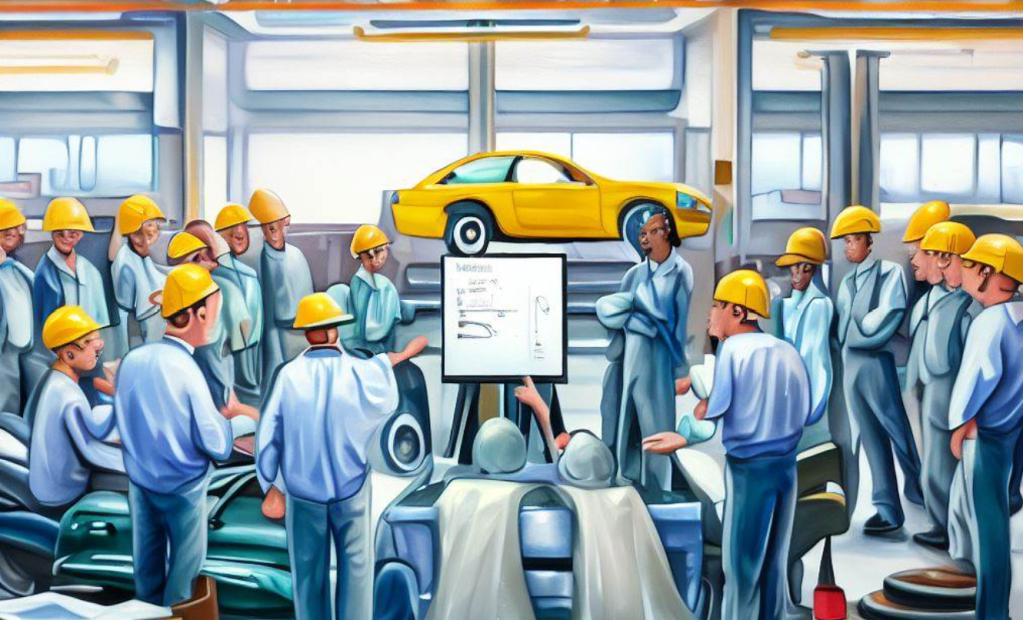
Improving performance thanks to Lean.
Definition of Lean. Definition written by Womack and D. Jones “The machine that changed the world”.
“Customer engagement and their desire to promote the service(s) they have purchased stems from the engagement of the company’s employees. Employee engagement starts from a simple premise: every employee is rich in know-how, feelings and ideas. Lean tools are learning tools, which allow experimentation, within teams which appropriate their results, collaborate with other teams, with a view to continuous development. The manager is no longer the one who makes things happen but the one who makes people learn. The manager relearns to be on the pitch. He achieved his goals by developing his people.”
Lean is a system that improves performance by eliminating waste and engaging customers and employees in learning and problem-solving.
Definition of continuous improvement
It is important to understand the notion of process, a central element of a Lean or Quality (ISO) system. We will seek to understand the value chain in the working methods and the various processes, by nature transversal and analyze the risks, the waste and the problems to be solved. Continuous improvement needs team commitment and participation to exist. The primary objective of a continuous improvement approach is not the search for performance, even if it contributes to it, but rather organizational learning.
“Continuous improvement is first and foremost a process characterized by small incremental changes in a productive process.”
John Bessant
Continuous improvement, Kaizen in Lean, is above all a way of learning to think and behave within the company. Learning becomes the most important objective here. This approach is not accompanied by imposed Lean tools, it is rather a philosophy of work and life. Problems are no longer hidden but highlighted because they give everyone the opportunity to learn and grow. What creates value? Are there wastes and how to eliminate them?
Continuous improvement is a process and a philosophy of small changes that create value and learning opportunities.
History of Lean. Taiichi Ohno: Toyota Production System Hero.
Taiichi Ohno joined Toyota after World War II. The production of Toyota “first Japanese car” only totals a few dozen vehicles per year, including military trucks for the American army. Everything is lacking in a Japan devastated by war and defeat, starting with raw materials. The firm is on the verge of bankruptcy and licensing.
Toyota owner Mr. Toyoda made a request to Ohno: “We absolutely have to catch up with the United States within three years, otherwise the Japanese automobile industry will die. and sends Taiichi Ohno to the United States to visit a Ford factory as part of an American-Japanese development partnership, Toyota being a supplier of trucks for the American army stationed in Japan.
But Ohno realizes the impossibility for Japan to copy the United States and notes that the productivity of an American worker is nine times higher than that of a Japanese.
To compete with the Americans with alternative methods to Taylorism and Fordism, which cannot be transposed to Japan, which is financially unable to manage significant scrap and considerable stocks, it is necessary to lower costs while producing short series. In reaction, without financial means, he then designed his method of five zeros, including the famous zero delay of “just in time”, the future Pillar of Lean Manufacturing.
At the start, Ohno had to face the reluctance of the workers whom he asked to become more versatile in order to be able to operate several machines at the same time, contrary to the direction of the division of labor desired in Taylorism and Fordism. By breaking specialization, it made it possible to increase the productivity of Toyota lines with less manpower, leading to a drop in the cost of the parts produced.
The TPS system (Toyota Production System) has since been extended to all sectors of activity and applies to all business processes; Management, Strategy (Hoshin Kanri), Innovation, Marketing, Finance, Production, Supply chain…
In 2007, Toyota became the world’s largest manufacturer and remains the first in 2021 with 10.5 million vehicles. The Toyota Group is also ranked first and second in Vehicle Quality with Lexus and Toyota.
Aware of the criticisms and the complex social dimension inherent in human complexity, Toyota is constantly improving its system (Toyota Way) in order to continue to rationalize and make intelligence and human psychology coexist with Artificial Intelligence and robots.
Current philosophy (Lean Institute).
The current philosophy is very close to the original philosophy of Taiichi Ohno. It seeks to create value with fewer resources and aims to eliminate waste. Lean is understood as a practice of permanent experimentation seeking to achieve perfect value and producing no waste. Thinking and Lean Practice merge. But if the system tends to reach perfection, it will never be able to reach it because the characteristics of this perfection are constantly changing.
The customer is at the center of the vision. What does he want ? What problem does he want to solve? What concrete action should be taken to satisfy it? The Lean practice only seeks to engage, directly or indirectly, actions that create value for the customer and the people performing these actions.
Through experimentation, managers and employees learn through their work, physical or intellectual, to improve quality and reduce deadlines, efforts and costs.
An organization that practices Lean is highly agile in the face of a volatile, uncertain, complex and ambiguous environment, thanks to the learning and continuous improvement integrated into Lean thinking and practice.
A Lean company is organized to continue to understand its customers and their contexts, bring them more value and always seek better ways to provide it, whether at design, order, delivery, installation, maintenance or end of life-recycling.
The foundation of Lean thinking remains fundamentally humanism. She advocates respect for customers, employees, suppliers, stakeholders and communities with the firm conviction that everything can and will be better through Lean practice.
Lean is therefore neither dogmatic nor rigid but progresses perpetually, in the face of each situation and as long as the value is imperfect and waste exists.
In summary. Lean is a system and a philosophy of performance, learning and value.
- Process maturity and continuous improvement are central to Lean or Quality systems.
- Lean is based on the original vision of Taiichi Ohno and involves constant experimentation and learning to achieve perfect value and reduce waste.
- Lean is defined as a system that optimizes the value stream by eliminating waste and increasing customer satisfaction.
- Lean puts the customer at the center of the process and seeks to understand and satisfy their needs and problems through quality and efficiency.
- Lean tools are learning tools that enable teams to experiment, collaborate and develop continuously.
- The manager’s role is to facilitate learning and problem-solving on the field, not to dictate actions.
- Lean makes the organization agile and adaptable to changing environments and customer contexts by integrating continuous improvement into all aspects of work.
- Lean is founded on humanism and respect for all stakeholders and communities, and believes that everything can and will be better through Lean practice.
- Lean is not a fixed or dogmatic system but a dynamic and evolving one that progresses with each situation and challenge.
- Continuous improvement is a process of small incremental changes that foster organizational learning and value creation.
- Continuous improvement is also a philosophy of work and life that embraces problems as opportunities to learn and grow.
“Costs do not exist to be calculated. Costs exist to be reduced.”
Taiichi Ohno
 Happy CEO