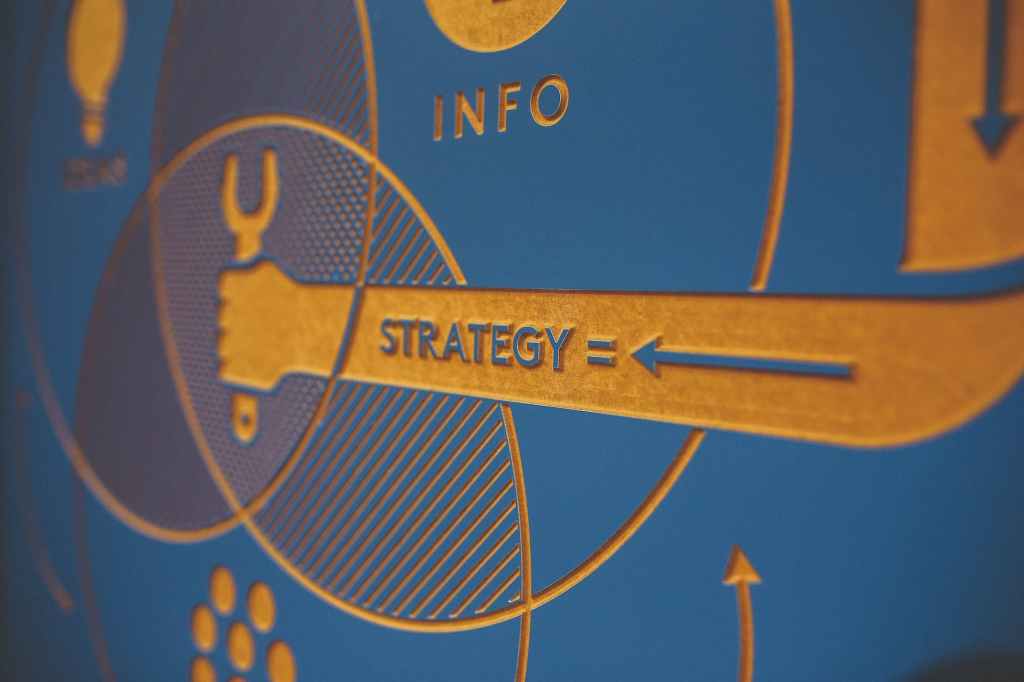
According to the Greek etymology, “strategia” means “command” with an evolution of meaning towards “the art of the strategist”, political and military art at this time and for many centuries.
In economics, strategy is a set of choices of objectives and means that guide the medium and long term activities of an organization or a group. (National Center for Textual and Lexical Resources, 2022).
The Strategy section of our website focuses more particularly on the management of companies during periods of crisis that hit economies every ten to fifteen years. These crises, by the degree of their forces and the risks they pose to companies, force decision-makers to govern differently and in a context of resilience.
Simplicity
If the abundant economic literature and the “business” training courses that are offered to steer our development models have a prospect of growth, very few existing training and content shared to help managers run their business talks about downfalls, downsizing, enforced frugality, and managing anxious teams in the face of doubt.
Faced with the shocks of crises, companies must find, in an emergency situation, the resources to adapt both financially and technologically. The instability in which the crises plunge the companies pushes them either to reduce their expenses, or to transform the fixed expenses into variable expenses thus to subcontract, sometimes to relocate, amplifying even more the phenomenon of crisis on the scale of a region, a nation.
Crises being natural and therefore inevitable, is there a model to prepare for them and allow the organization and its people to adapt to them?
“What is called the crisis is only the long and difficult rewriting which separates two provisional forms of the world”
Jacques Attali
Aiming for organizations that are agile, flexible, responsive and capable of producing as much or more with fewer resources, such is the challenge… and the promise of Lean, the Toyota business model.
From shrink to lean
This “lean, light, no-frills” organizational system was itself originally designed to respond to a problem of lack of sufficient resources. Is Lean Management the example to follow in preparing his business to navigate in stormy times?
In this perspective, what is the place of the human in this dynamic?
Human centric model
As in any human adventure, the mental resource, the motivation of the group remains the major objective of any strategy. And what differentiates a crisis strategy from a strategy in a period of growth is the pace with which the leader must decide and act, which implies a high speed of information acquisition and therefore a transmission system high-performance (intelligence) information.
Preparing the system to react and controlling the performance of these reactions is the object of our learning-teaching approach.
“Strategy is choice. Strategy means saying no to certain kinds of things.”
Michael Porter
 Happy CEO