

We learned at university in England this effective theory on the tactics of war applied to Marketing. Military strategy is the art of coordinating, at the highest decision-making level, the action of all of the Nation’s armed forces to conduct a war or preserve the peace.
The military combine their means and resources on three levels:
- The strategic level (politico-military).
- The operational level where decisions are made.
- The tactical level where the action is articulated and piloted locally.
“It is your own bad strategies, not the unfair opponent, that are to blame for your failures. You are responsible for the good and bad in your life.”
Robert Greene
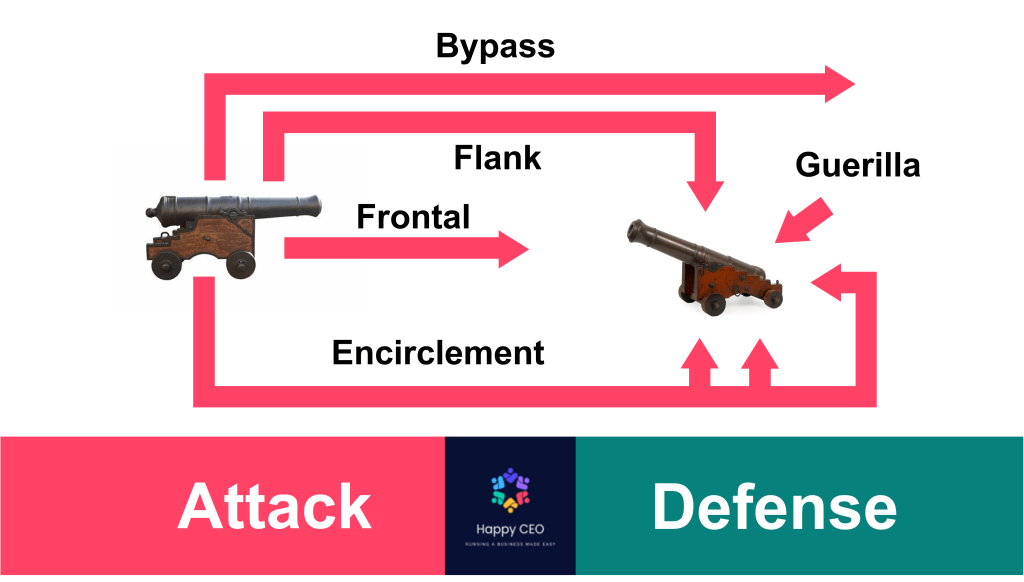
Attack Strategies
Frontal: Attacking your competitor directly on the product offer, price, advertising, distribution.
On the flank: Attack unserved segments or unserved regions of the world by adapting its offer.
Guerilla: Very regular intermittent attacks on promotions and prices.
Bypass : Diversification strategy. Offer products not offered by your competitors.
Encirclement: Launch of a major offensive against the leader (expensive option) combining several attack strategies.

Defense strategies
Static: This is marketing myopia. The world moves… but not you!
Mobile: This involves expanding and refreshing the range and number of references of your existing product offer. This is differentiation.
Counter-offensive: You set up actions to promote or animate your offer in response to the attacks of your competitors.
Prevention: “Prevention is better than cure”. Strengthen your weak points.
Innovation and R&D: This is the creation of value on the offer, the service and the economic model.
Withdrawal: It is impossible to line up. You have to withdraw.
Limits of this strategic vision
Corresponding to a vision of the world of the 90s, this metaphor for war strategies is certainly easy and useful but unethical. It gives a negative perception of entrepreneurship and educating young people by telling them that opponents must be killed is negative and leads to unfair or slanderous practices.
Other images seem more appropriate to us to evoke the company. Games, sports, competition, the life of organisms, nature, teamwork…
Moreover, this metaphor is not customer-oriented and is limited to precise positioning between two competitors. This strategic vision must be linked to the life cycles of the products of all the areas of activity in which the company is involved.
“Today’s digitized and globalized economy is collaborative.”
Commitment and trust are needed between partners to form successful strategic alliances. It is common today for companies that are not in the same industry to join forces to create offers aimed at the same clientele.
Moreover, even if the competitors are from the same industry, they sometimes cooperate.
Instead of persisting in trying to kill this or that competitor, companies should instead find a way to develop their internal strengths and fix their weaknesses.
But above all, they must commit to listening to the specific needs of customers around the world to become truly internationally oriented.
“It is true that sometimes soldiers, exaggerating the relative impotence of intelligence, neglect to use it.”
Charles de Gaulle
 Happy CEO