
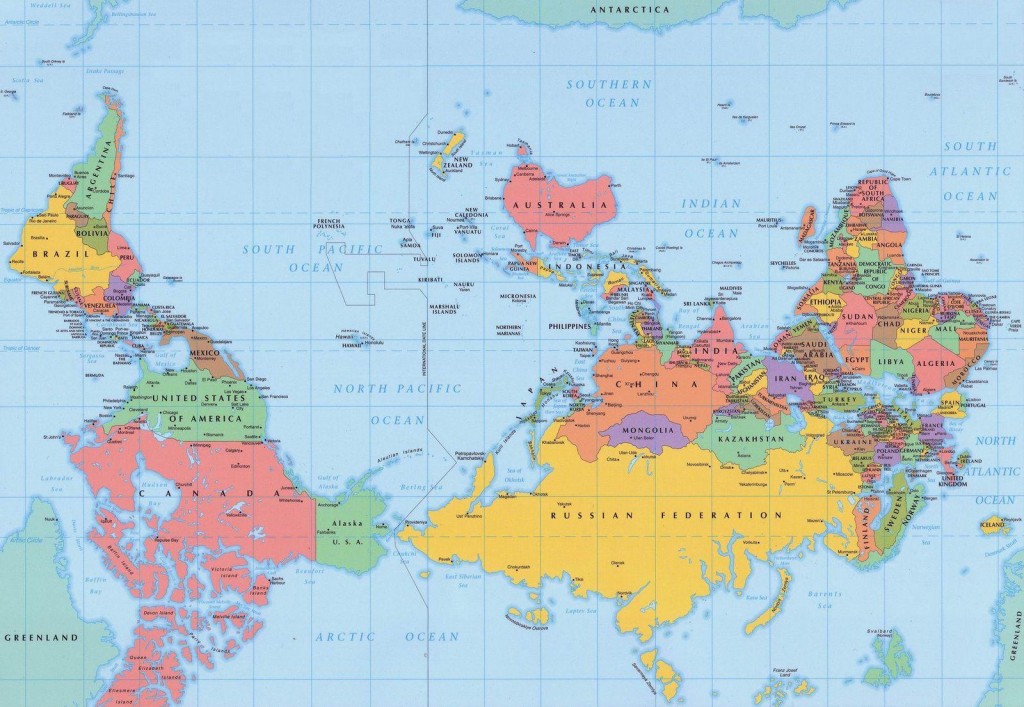
Look at this map of the world.
What inspires you?
How does it change your perception of reality?
What do you remember?
Due to obstacles coming from the sheer volume of information we have to process every day, we avoid seeing the world as it is. We actually perceive only a very small part of reality.
We impose imaginary constraints on ourselves
We unconsciously fall victim to optical illusions and differences in perception that are the result of subjective factors; prejudices, culture, customs, habits, experience.
Individuals don’t perceive reality in the same way. We process stimuli into categories that suit us.
It is the brain that makes mistakes and deceives us.
We develop tunnel vision
This restricted vision prevents us from perceiving the world around us. We need to be aware of the nature of our biases.
We must be attentive to the evolutions of the world and the differences of cultures, to think outside the box, to break the filter of our emotions which keep us away from all the richness of the world.
By changing our view of the world around us, we benefit from unexpected perspectives.
How to expand your horizons and enrich your understanding of the world
- Be aware of your own assumptions and beliefs.
We all have them, and they can influence how we interpret the information we receive from our senses. Try to question your own judgments and opinions, and be open to alternative perspectives.
What are some of the assumptions or beliefs that I have about myself, others, or the world? How do they affect my perception of reality? - Seek feedback from others.
Sometimes, we need another pair of eyes to help us see things more accurately. Ask for honest and constructive feedback from people you trust, and listen to their views without being defensive or dismissive.
Who are some of the people that I can trust to give me honest and constructive feedback? How can I ask them for their opinions and listen to them without being defensive or dismissive? - Learn from different sources and experiences.
The more you expose yourself to different cultures, ideas, and viewpoints, the more you can expand your horizons and enrich your understanding of the world. Read books, watch documentaries, travel, or try new hobbies that challenge your assumptions and broaden your knowledge.
What are some of the sources or experiences that I can explore to learn more about the world and different perspectives? How can I challenge my assumptions and broaden my knowledge by reading, watching, traveling, or trying new things? - Practice mindfulness (or meditation).
These techniques can help you become more aware of your thoughts and feelings, and reduce the influence of stress and emotions on your perception. They can also help you focus on the present moment, and appreciate the reality as it is, without judgment or distortion.
What are some of the techniques or exercises that I can practice to become more mindful and meditative? How can I reduce the influence of stress and emotions on my perception by focusing on the present moment and appreciating the reality as it is?
In summary, how we can improve our vision by being more open-minded and curious
- We only see a fraction of reality due to the limitations of our brain and the influence of our biases.
- We tend to categorize and simplify the world according to our own preferences and experiences.
- We miss out on the diversity and richness of the world by having a narrow and fixed view of it.
- We can enhance our perception by being aware of our blind spots, exploring different cultures and perspectives, and challenging our assumptions.
“Awareness is a key ingredient in success. If you have it, teach it, if you lack it, seek it.”
Michael Kitson
 Happy CEO