
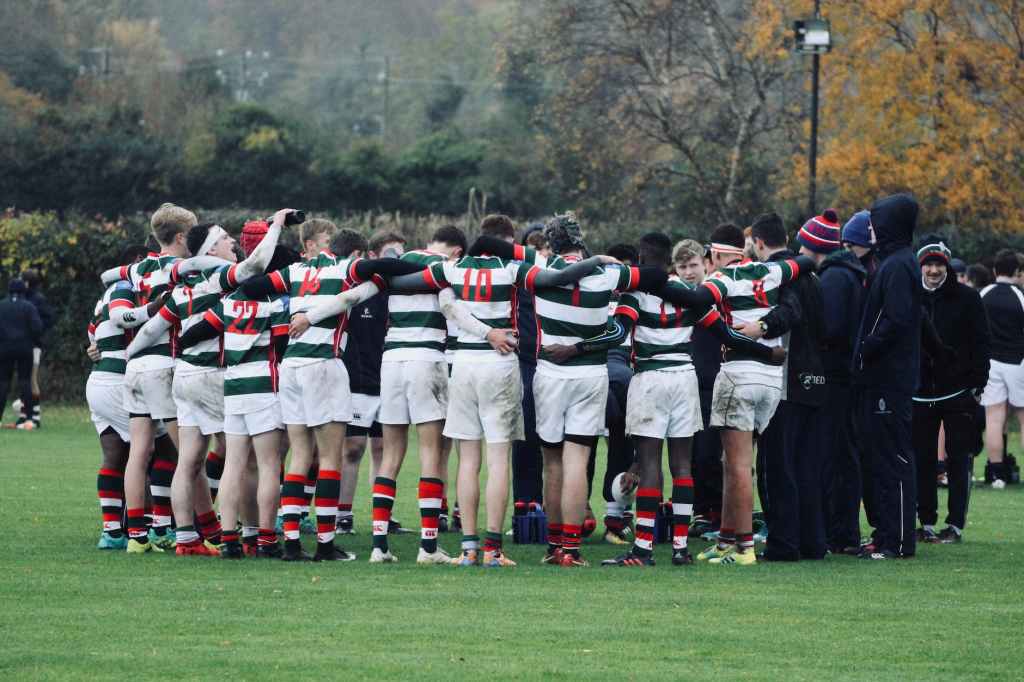
How to combine the high level requirements of managers with the contributions of rugby to the performance of men and teams?
As a former Rugby player and Coach, I wanted to share with you some of the techniques learned and developed on the field or at the back of the dressing room. These methods can be transposed to your businesses.
As you know, Rugby today conveys very positive values; team spirit, total commitment, courage, solidarity, authenticity, friendliness, fighting spirit.
What are the transferable values in the management of your teams?
- How to identify and carry out a game project to achieve its objectives ?
- How to motivate men to give the best of themselves thanks to mental management ?
- How to build a training and set up specific sequences aiming at a progression ?
- How to use Rugby methods as a source of progression to the highest level ?
- How to help players to manage the defeat, the decrease in performance ?
- How to share the essential value for success and performance?
In order to meet the requirements of business performance, for each member of your team, be sure to assess and develop the following resources through highly targeted training sequences:
Perception: Cognitive and mental resource.
Intelligence in action: The training will aim to put employees in a situation of effective repetition of an action aimed at a very effective immediate “reflex” response. For example, the theatrical repetition of the arguments (in another language for non-natives speakers if necessary) and the response to objections without any hesitation.
Pre-action: This is everything that relates to analysis work in real situations. The employee must analyze and anticipate what will happen. We will ensure, for example, that they acquire the basics of empathy, intercommunication and active listening but also allow them to learn how to quickly decode situations ; the buyers’ methods for example.
The technique: Mental and motor resource.
Versatility: You can specialize your employees to excel in a position. Sometimes it is advantageous or necessary to have polyvalent employees, especially in small and medium entreprises. It is essential to know how to assess needs and to allow everyone to progress in each to evolve towards real professional expertise in each facet of their job.
Specificity: Similarly, each company evolves in a different environment. Each employee must understand the environment in which he evolves and develop real know-how specific to his industry while maintaining the necessary adaptability for international business in order to know how to adapt his response to the needs of the target market.
The psyche: Mental and affective resource.
Concentration: You must ensure that your employees benefit from periods of thinking and concentration in their working day to carry out effective work on intellectual tasks. They must have enough calm to be able to concentrate during these periods.
Resistance to stress: The action of the manager will monitor the level of stress and provide the management keys in order to effectively regulate the effects of positive stress versus negative stress.
Motivation: We could write a whole book about it. Motivation is “the key factor” in performance. The manager must influence the motivation of the group. If he does not influence, he misses an essential dimension of his responsibilities.
“Champions aren’t made in gyms. Champion are made with someting they have deep inside them. A desire. A dream. A vision.” Muhammad Ali.
4 moments of truth
To simplify, we will say that there are 4 different moments when we can act on mental preparation :
- Preparation of an action.
Prepare an impactful speech and highlight the determining objectives, the content to be able to achieve the team goals and the corporate strategy. This speech will contain the challenge of the goal for the company (weak, strong, maximum), the balance of power, the psychological climate in which you want to immerse your employees, the technical-tactical content specific to this action. The attention paid to your speech is a factor in the effectiveness. This mental preparation is essential to help your employees manage their stress. - Observation and evaluation of performance during the action.
You must determine what you want to observe, define your performance criteria and make an analysis grid.
- Performance indicators, successful actions, failures, statistics…
- Adequacy between employee behavior and predefined strategy to link Instructions/processes.
- Dynamics of progression, stagnation, regression.
- After the action. Feedback debriefing.
After the action, you must do an informal analysis of your collaborator performance in verbal form. You can use a video recorder to see people’s weaknesses and work to improve. This is when the coaching in performance of your employees takes place.
This involves having him a fully integrated knowledge of his job, the philosophy of the company and his know-how in order to make him adhere to a “collective project” which becomes “his project”.
Your approach to business must become “his approach” to business so that, as a true professional, he can practically no longer need you.
It is the mark of great international players who are completely autonomous and masters of their techniques and their arts. A mental preparation process has the ultimate goal of maximum employee empowerment. - The 3rd half-time.
It will certainly make you smile, but the third-half has a special flavor and function for us Rugby players. Its primary purpose is communication. It will allow your collaborators to disconnect and say verbally all that they failed to achieve during the action, which was misunderstood.
It promotes complementarity and the interpretation of gestures and behaviors (motor communication). We try to redo the action, to reconstruct it mentally to tend towards the perfect action. The second reason is festive and therefore relational. It allows your employees to get to know each other and you in a different way and to forge links other than professional and technical.
After all, your employees spend more time in your company than at home. The 3rd half has a true, real, authentic deep meaning. Here, employees become men and women first and foremost. You have an important role to play.
First psychological and human because your employees can free themselves from the professional shackles that usually and constantly connect them to you. Communication here is centered on the being, on the relationship as a motivational dynamic of recognition.
Then, this type of event claims a certain culture of fraternity as an heritage. Quality of life comes first and belonging to a group is a strong human need. You must safeguard shared values of conviviality rooted by a multiplicity of local, regional cultures.
“When I played, some of the best moments in rugby were with the guys who you have just gone 80 minutes with and you find out they are just like us. They are ordinary guys and you make lifelong friendships.” Steve Hansen. Former All Blacks World Champions Coach.
Coordination: Motor and cognitive resource.
Balance: In rugby, we will analyze the player’s “motor” balance abilities. We would like to extrapolate this notion of balance to a social dimension of the balance of the employee. A balanced employee in his life is a high-performance employee.
Reaction time: Same as for balance, We will extrapolate reactivity not in motor terms but in economic terms. Economy today means speed and efficiency. Customers are globally dispersed, mobile and difficult to retain. The size of the company does not matter. It is worth less than before. Its speed of transformation and its ability to adapt are more significant than ever. “The fast eat the slow”. Integrate speed as an operating model.
Morphology and physicality : Affective, energetic and motor resource.
Height, weight, BMI, Power, Endurance, VO2max: Unless we are mistaken, these resources have a low impact on the intrinsic performance of your employees. However, we get our energy from our body, from our breathing, from our food. Body & mind harmony is essential to everyone’s balance. A healthy lifestyle and the practice of physical activity is recommended to resist in a job requiring many difficult tasks and travels. In addition, physical appearance plays an important role in self-confidence and the image that one inspires in others.
“All the talent in the world won’t take you anywhere without your teammates.” Anonymous
 Happy CEO