
Beauty = Well-being
Well-being = Creativity
Creativity = New ideas
Think back to all the office meetings, conventions, presentations you’ve been to.
- How much they deeply bored you ?
- How many could have been shortened ?
- How many repetitive, vague or even useless messages ?
- How many unreadable super loaded slides ?
Worse, the number of speakers who read exactly what is written on the screen without a single word exchanged with the audience.
“Often too much is the enemy of good.“
In many cases, the duration, the length of the slides, the quality of the messages seems unnecessary and often endless.
“Showing less is not doing less. Only the result counts.“
But very often, many managers are quite happy to reproduce word for word a simple sales pitch by mechanically translating it into an endless PowerPoint slideshow. Which is enough for many products, that’s true.
However, the superior value perceived by your customers for your solution is very important. It’s interesting to bring your product from a new, more creative angle that your customers have never seen.
Steps
- What is the main problem of my customers today ?
- What is the empty interval to be exploited ?
- What image will I finally give to my solution ?
- How to represent the problem, the empty interval and my solution?
Disconnect
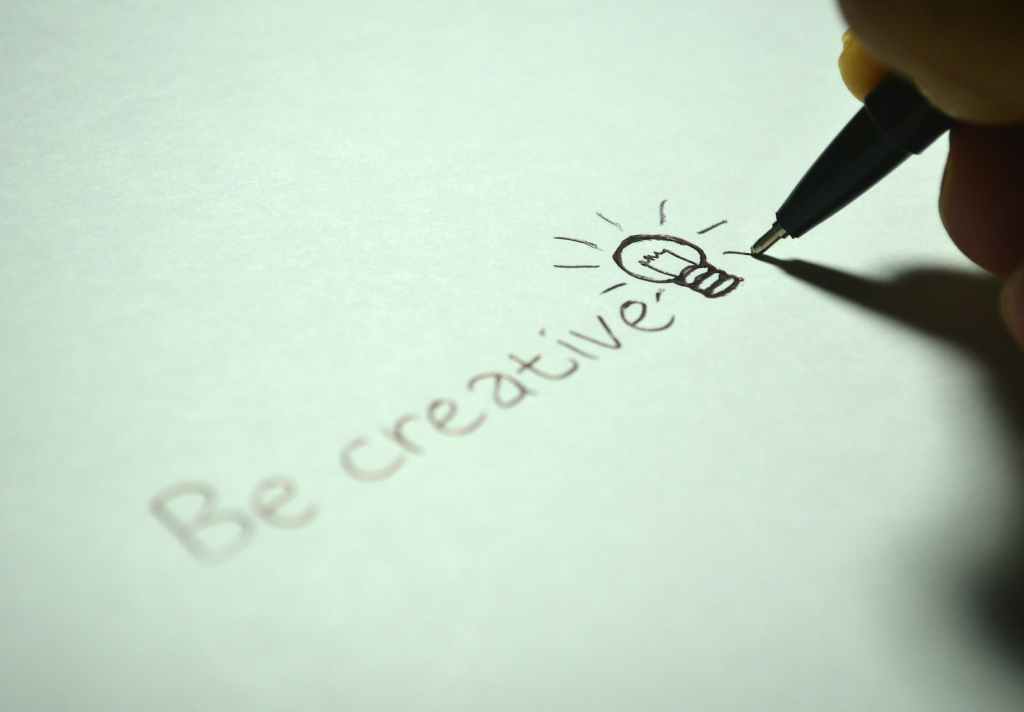
Let go of your office and your computer, take a blank sheet of paper, your most beautiful pencil, settle in an inspiring place for creation and let your imagination run wild.
- If you had to draw your argument or your product, how would you represent it ?
- What would be your artistic approach ?
- What are the key aspects that would highlight it the most ?
- What image should people retain ?
Once your elements have been well thought out and defined, draw a script, a mini scenario. Put your ideas in the paper. Your drawings, even approximate, are ultimately the fundamental characteristics of your business approach.
Maybe you will express a new concept that will gain you market share.
Your advantage is that your new presentation, very visual or even artistic, expresses the essential meaning of your message in a very emotive way, whatever the language of destination.
Why is sketching important?
Very often in the office, when we remain chained in the same creative process, the same IT tool, we lock ourselves into a precise software framework with its predefined technical limits and constraints.
Even worse is spending hours on an image bank to find the one that best represents a concept that you have in mind but which is ultimately blurred.
With pens, you have no limits. Once you have found the framework of your message, take your computer and change dimensions… Your presentation can then take a paper, web or video form, even almost theatrical.
Key creative principles
- Even if you are not Van Gogh or Picasso, you have ideas. Express them graphically. That’s what we’re looking for.
- Keep in mind that this process aims to seek solutions.
- Generate emotion.
- Think “value” for your customers. Forget the characteristics of your products and answer to an expressed problem.
- Establish clear priorities in your sketches. What should my clients remember in the end ?
- Know that simplicity is more difficult to obtain because you must increase the impact of your message by saying as little as possible.
- Pay attention to the length of your presentations.
- Expect less. Think of people who suffer in meetings…
- Remember to convince above all, the purpose is not the visual which remains a framework for thought.
- Use vacuum. Don’t make the mistake of thinking that a free space needs to be filled. The subtlety is precisely that the void draws the eye to your key idea. This is why an endless list of arguments is ultimately uneffective.
In summary, Creative thinking: Why it matters and how to do it
- Creativity is essential because it helps to:
- Generate new ideas and solutions that add value for customers
- Express the meaning and emotion of the message in a visual or artistic way
- Stand out from the competition and gain market share
- The creative process involves:
- Identifying the main problem, the empty interval, and the image of the solution
- Disconnecting from the office and the computer, and using pens and paper to sketch the ideas
- Drawing a script or a scenario that shows the key aspects of the message
- Adapting the presentation to different formats and dimensions
- The key creative principles are:
- Simplicity, clarity, and priority of the message
- Emotion, value, and conviction of the message
- Use of vacuum, contrast, and balance in the design
“Art is not what you see, but what you make others see.”
Edgar Degas
 Happy CEO